
AI can be your mentor. It can compress centuries of wisdom into seconds. But should it?
I love to play the game of “What if” with AI. My favourite playmates in these games are Claude and ChatGPT, but they’re all good at it.
So, I wondered:What if I ask AI to ingest the full body of writing, talks, and interviews from an innovator I admire, like Muhammad Yunus, reconstruct a reasoning model of his mentoring style, and simulate a real-time dialogue where he advises me on my current project?
It’s not as crazy as it sounds. Not easy, maybe. But with enough material, you can achieve fascinating results.
As Chief Innovation Mentor at MentorLab Group, I explore these questions and do these experiments daily, leveraging AI to develop enhanced mentoring programs while never forgetting what only humans can do. It’s incredible what you can do.
You could also ask AI to analyze massive datasets about innovators like Nikola Tesla, Wilson Greatbatch (the accidental inventor of the implantable pacemaker), Ole Kirk Christiansen (the carpenter who founded LEGO), or Art Fry (who created the Post-it note). AI could extract the hidden patterns behind their success—and create a “personalized mentor” for you.
You can.
The tools are here.
But will it work?
And if it’s so easy, why isn’t everyone doing it?
Maybe because knowing is not enough. Maybe because there’s more to mentorship than knowledge transfer. Maybe because AI can tell you what matters, but it can’t feel it.
Trailblazers didn’t follow maps. Greatbatch didn’t know he was about to create a medical device that would save millions of lives. Ole Kirk Christiansen wasn’t following a playbook when he shifted from making wooden toys to plastic bricks. Yunus didn’t have a pre-modeled strategy when he launched microcredit—he was improvising, responding to human need.
They didn’t have all the dots connected before they acted. They became innovators by stepping into the unknown, not by perfectly following a pattern.
Human mentors don’t know it all, either. And that’s what makes them special. They don’t give you certainty; they give you presence in uncertainty. They don’t just help you connect the dots; they help you dare to create dots that don’t exist yet.
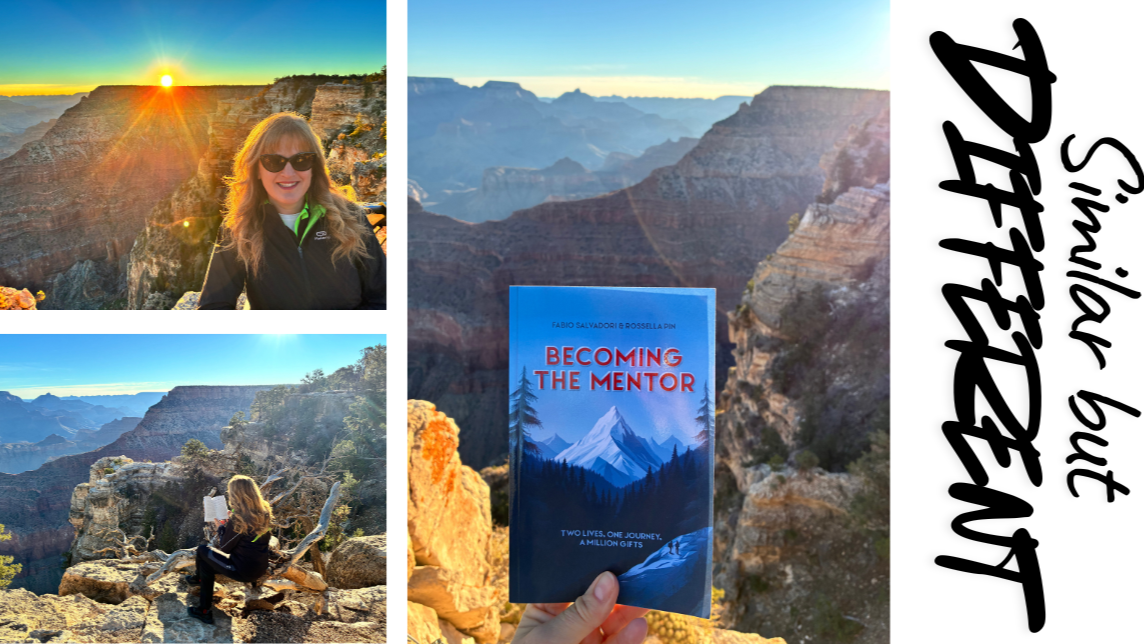
There’s a moment I particularly love in our book “Becoming the Mentor“. During one of the first conversations, even before becoming Nemo’s mentor, Scarlet dares to say: “Here’s my secret: I don’t know.” That created a space where not knowing was not a limit; it was a possibility.
AI can simulate a mentor. It can accelerate learning. It can model wisdom. But only a human mentor can sit with you in the not-knowing, the hesitation, the fear, and still believe in your ability to leap.
Maybe the future isn’t about replacing mentors with AI.
Maybe it’s about letting AI handle the knowledge, so humans can keep mentoring us in the art of the unknown.
That’s what we do here at MentorLab. We use AI to handle the knowledge and the complex tasks, so we create space for the human side to shine. The results have surprised even us, but that’s a story for another article.
And still, I wonder:
If AI can compress centuries of wisdom, will we still value the slow, messy art of learning from another human?