
Since childhood, I walked the Alps with my father. The pattern was always the same: the fatigue of going up, the reward of seeing the landscape from above, and the joy of descending while singing. That rhythm—effort, insight, release—shaped my early understanding of what transformation feels like.
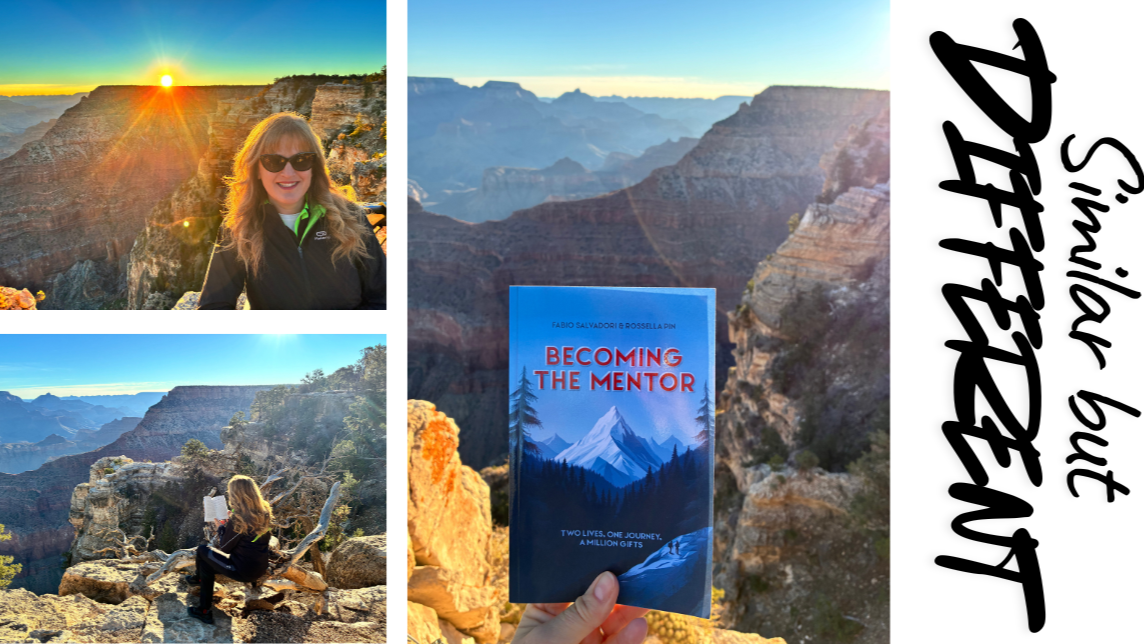
During my recent trip to the Grand Canyon, for the first time I could look down into an immense landscape without having earned the view through physical effort. That inversion challenged my assumptions about perspective and made me reflect on how these early experiences shape the way we see ourselves, our capabilities, and even our culture. I opened my book at random, and the page I landed on was the chapter “Similar but Different.” It could not have been more fitting.
In Joseph Campbell’s Hero’s Journey, the descent into the Inmost Cave is the moment when the hero confronts fears, sheds limiting beliefs, and prepares for transformation.
I had always struggled to imagine this descent into the unknown. But walking down toward the Colorado River, I realized that the inner journey can feel surprisingly easy, even enjoyable. The landscape was captivating, drawing me deeper without resistance.
Yet that ease is deceiving. The true challenge is not the descent—it is the climb back. Without someone who has lived the journey and understands what it means to return to the ordinary world transformed, the experience can be risky.
Deep transformation requires preparation, resources, time, and the guidance of someone who has traveled that path before.
This is precisely where the distinction between coaching and mentoring becomes essential. A coach helps you clarify objectives, visualize outcomes, and plan resourcefully. A mentor does that as well—but with one fundamental difference:
A mentor has lived the experience first.
They can share their learnings, their failures, their insights, and their maps. And because of that, you can navigate your own journey more consciously, more effectively, and—at times—more masterfully.
That is why we say that the mentee eventually surpasses the mentor. The journey they make will be informed by the mentor’s experience yet shaped by their own choices. Similar, but different.
This time, I accepted the invitation of my adventure mentor, Marcia Reynolds, PsyD, MCC, to go only halfway down. I will train, prepare, and return when I can take the full journey with intention. And that mirrors the experience of every mentee: drawn by curiosity, strengthened through guidance, and ultimately transformed through the ascent.
Similar but different—whether looking up at the Alps or down into the Canyon, perspective shapes the journey. Mentors and mentees may stand at different vantage points, yet they commit to navigating the same terrain.
And the true value of that mentoring relationship lies in having someone who understands both the descent and the ascent, and is willing to walk the difficult parts with you, bringing clarity, courage, and shared purpose.
If this reflection resonates with you, I invite you to read the chapter “Similar but Different” in the book I wrote with Fabio Salvadori, Becoming The Mentor: Two Lives, One Journey, A Millions Gift.